
Earlier today, the Mets beat the St. Louis Cardinals 4-1, finishing off a victory over the defending league champions in a four-game series, 3-1. The win improved their record for the young season to 12 wins, 10 losses. They're tied with the Washington Nationals, the consensus pick to win the division, for second place in the National League East. So far, they look... pretty good.
And yet, so far they look absolutely terrible. Including today's game, Fangraphs pegs the Mets' batters at 1.0 Wins Above Replacement on the year, 28th in baseball, ahead of only the Diamondbacks and the 220-losses-in-the-past-two-seasons Astros. Mets pitchers, meanwhile, they have at 0.6 WAR, 27th in the league, ahead of the D-Backs, the Pirates, and the Reds. Admittedly they think the pitching has been a little bit better by runs allowed rather than by fielding-independent pitching, at 1.4 WAR, 21st in baseball. But still, at best the team has been terrible on offense and bad at pitching. To put it another way, the offense is sporting a .218/.296/.316 batting line, "good" for a .276 wOBA (which is terrible for a middle infielder) and a 76 wRC+, way below league average. The pitching, meanwhile, has an ERA- of 110, a FIP- of 112, and an xFIP- of 104. That's 24 points below average on offense, and something between 4 and 12 points below average on pitching. That's a terrible team. It's not a team that's two games over .500 and looking, just on the basis of wins and losses, like a possible Cinderella contender.
Showing posts with label Curtis Granderson. Show all posts
Showing posts with label Curtis Granderson. Show all posts
Thursday, April 24, 2014

Sunday, April 20, 2014
The Sacrifice Fly is Ridiculous
In the bottom of the first inning of today's Mets game, Eric Young, Jr. led off with what should have been an easy fly-out to left field but was instead missed by Justin Upton, putting Young on second base. Curtis Granderson hit a fly ball to deep right field, which was caught but which advanced Young to third. The Braves played the infield back, and David Wright hit a ground ball to second base. Because he was playing back, Dan Uggla had no chance to get Young at home, so instead he threw Wright out at first while the run came in. It was pretty obvious that Wright did more or less what he was trying to do. He wouldn't have minded doing more, but he just wanted to make sure that, since the Braves were giving him a run if he could just hit the ball on the ground, he got the job done. He walked back to the dugout not really feeling like he had failed. Nevertheless, the play lowered his batting average. (In fairness, he did then
get four hits the rest of the game, so it's not like his batting average
is really hurting for it right now.)
In the bottom of the 14th inning of the same game, with the score tied at 3, Kirk Nieuwenhuis led off with a walk. Ruben Tejada then hit a successful sacrifice bunt to advance Kirk to second base, prompting the Braves to take the curious step of walking Eric Young, Jr., who's struck out in every single game he's played this whole season, to pitch to Curtis Granderson, he of multiple 40-home run seasons in his past. That tells you how much Granderson has been struggling. It didn't really work out for Atlanta, though; their pitcher, Gus Schlosser, uncorked a wild pitch almost immediately, moving the runners to second and third with one out, meaning that Curtis only needed a fly ball to win the game. He got it, hitting it just deep enough to left field that, given Nieuwenhuis's speed, the winning run scored before Upton's strong throw had even reached home play. It was again obvious that this was exactly what Granderson had been trying to do, since, y'know, it would win the game, whereas if he struck out, or hit the ball on the ground to one of the drawn-in infielders, the Braves would have a chance to get out of it. Accordingly, this play did not lower his batting average, registering instead as a sacrifice fly. After all, it wouldn't be right to punish Granderson statistically for succeeding, right?
You can see the contrast I'm trying to set up here. Apparently a sacrifice fly hasn't counted as an at-bat since 1893, but the sac fly as a statistical category in its own right has only existed intermittently since then. It had a couple of brief runs prior to World War Two, but was finally instituted for good in 1954, and it's typically only since then that sites like Baseball-Reference give the SF stat. The theory behind it is that, in the sorts of situations in which a player can score on a fly ball, the batter is quite likely trying to hit a medium-deep fly ball, rather than trying to do anything more, even though they'll be out on the play. Except... isn't a batter also "trying," in exactly the same sense, to hit a weak ground ball to get a run in when the defense is conceding that run? Of course, it's arguable to consider that "trying," unlike with your average sacrifice bunt attempt, but I don't think it's much more or less arguable than the logic behind the sacrifice fly.
I'm not sure what I think should be done about this. Discontinue the sacrifice fly? That would feel very strange, if nothing else, since it's been around for the entire lives of most baseball fans. Decide that an RBI ground-out won't count as an at-bat either? That would perhaps be equally weird. Decide that on-base percentage, which has never exempted batters from the out made on a sac fly (though it does exclude sacrifice bunts, sensibly), is more important anyway? Yeah, that's probably the one. But since today's Mets game featured both ends of this disparity so prominently, I just wanted to point it out.
In the bottom of the 14th inning of the same game, with the score tied at 3, Kirk Nieuwenhuis led off with a walk. Ruben Tejada then hit a successful sacrifice bunt to advance Kirk to second base, prompting the Braves to take the curious step of walking Eric Young, Jr., who's struck out in every single game he's played this whole season, to pitch to Curtis Granderson, he of multiple 40-home run seasons in his past. That tells you how much Granderson has been struggling. It didn't really work out for Atlanta, though; their pitcher, Gus Schlosser, uncorked a wild pitch almost immediately, moving the runners to second and third with one out, meaning that Curtis only needed a fly ball to win the game. He got it, hitting it just deep enough to left field that, given Nieuwenhuis's speed, the winning run scored before Upton's strong throw had even reached home play. It was again obvious that this was exactly what Granderson had been trying to do, since, y'know, it would win the game, whereas if he struck out, or hit the ball on the ground to one of the drawn-in infielders, the Braves would have a chance to get out of it. Accordingly, this play did not lower his batting average, registering instead as a sacrifice fly. After all, it wouldn't be right to punish Granderson statistically for succeeding, right?
You can see the contrast I'm trying to set up here. Apparently a sacrifice fly hasn't counted as an at-bat since 1893, but the sac fly as a statistical category in its own right has only existed intermittently since then. It had a couple of brief runs prior to World War Two, but was finally instituted for good in 1954, and it's typically only since then that sites like Baseball-Reference give the SF stat. The theory behind it is that, in the sorts of situations in which a player can score on a fly ball, the batter is quite likely trying to hit a medium-deep fly ball, rather than trying to do anything more, even though they'll be out on the play. Except... isn't a batter also "trying," in exactly the same sense, to hit a weak ground ball to get a run in when the defense is conceding that run? Of course, it's arguable to consider that "trying," unlike with your average sacrifice bunt attempt, but I don't think it's much more or less arguable than the logic behind the sacrifice fly.
I'm not sure what I think should be done about this. Discontinue the sacrifice fly? That would feel very strange, if nothing else, since it's been around for the entire lives of most baseball fans. Decide that an RBI ground-out won't count as an at-bat either? That would perhaps be equally weird. Decide that on-base percentage, which has never exempted batters from the out made on a sac fly (though it does exclude sacrifice bunts, sensibly), is more important anyway? Yeah, that's probably the one. But since today's Mets game featured both ends of this disparity so prominently, I just wanted to point it out.
Friday, December 6, 2013
If Only They Had Signed Reyes
Earlier today the New York Mets signed Curtis Granderson to a four-year contract. He'll be their everyday left fielder in 2014, probably. This is the Mets' second major move of the off-season, after the signing of Chris Young to play right field. Both are good signings, I think, though I was hoping they'd sign Shin-Soo Choo. So, what's left to do? Well, the most obvious remaining hole on the roster is shortstop. Also they don't really have any very good choices for leadoff hitter. Hmmm, I wonder... who could fill that void?
Oh yeah, this guy:

Seriously, letting Jose Reyes go was the biggest mistake the Mets have made in a long time. Imagine he were on the Mets instead of the Blue Jays right now. They'd have an offense consisting of Travis d'Arnaud at catcher, some sort of platoon of Josh Satin and one of Ike Davis or Lucas Duda at first, Daniel Murphy at second, Reyes at short, David Wright at third, Granderson in left field, Juan Lagares patrolling center, and Chris Young playing right, with the likes of Wilmer Flores, Eric Young, Jr., Matt den Dekker, or Ruben Tejada as backup players. Here's how I'd picture the default lineups with that roster:
vs. RHP: vs. LHP:
Jose Reyes, SS (S) Jose Reyes, SS (S)
Daniel Murphy, 2B (L) Juan Lagares, CF (R)
David Wright, 3B (R) David Wright, 3B (R)
Curtis Granderson, LF (L) Chris Young, RF (R)
Chris Young, RF (R) Curtis Granderson, LF (L)
Ike Davis, 1B (L) Travis d'Arnaud, C (R)
Travis d'Arnaud, C (R) Daniel Murphy, 2B (L)
Juan Lagares, CF (R) Josh Satin, 1B (R)
That's a good offense, if you ask me. And it's got plenty of flexibility with Young (Eric) and Tejada on the roster. Instead, Tejada's currently the projected starting shortstop, Wilfredo Tovar is the default backup infielder (I think), and the big free agent shortstop, Stephen Drew, is a bottom-of-the-order guy who does nothing to solve the leadoff problem. If Reyes were still on this team, in other words, it would look to have a very well-rounded, well-balanced offense heading into 2014, with the slightly messy first base situation by far the biggest problem. Instead they're looking at another year, likely, of struggling at the top of the order, which will probably spell trouble for the whole team. And sure, they could do something unconventional like just shift everybody up one, bat Murphy leadoff and Wright second, but that's not likely to happen under Terry Collins.
I'm not necessarily saying the Mets should try to trade for Reyes now, although I'd be overjoyed if they did so for a reasonable price. I'm just saying that the decision not to match Miami's offer two offseasons ago was inexcusable, remains by far the worse thing Sandy Alderson has done as Mets GM, and continues to haunt this team. Reyes is exactly what they need right now, and he's exactly what they don't have.
May the Yankees come to regret letting Robinson Cano go the way the Mets miss Reyes right now. (Off-topic, but necessary)
Oh yeah, this guy:
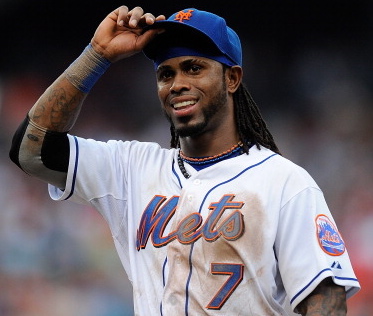
Seriously, letting Jose Reyes go was the biggest mistake the Mets have made in a long time. Imagine he were on the Mets instead of the Blue Jays right now. They'd have an offense consisting of Travis d'Arnaud at catcher, some sort of platoon of Josh Satin and one of Ike Davis or Lucas Duda at first, Daniel Murphy at second, Reyes at short, David Wright at third, Granderson in left field, Juan Lagares patrolling center, and Chris Young playing right, with the likes of Wilmer Flores, Eric Young, Jr., Matt den Dekker, or Ruben Tejada as backup players. Here's how I'd picture the default lineups with that roster:
vs. RHP: vs. LHP:
Jose Reyes, SS (S) Jose Reyes, SS (S)
Daniel Murphy, 2B (L) Juan Lagares, CF (R)
David Wright, 3B (R) David Wright, 3B (R)
Curtis Granderson, LF (L) Chris Young, RF (R)
Chris Young, RF (R) Curtis Granderson, LF (L)
Ike Davis, 1B (L) Travis d'Arnaud, C (R)
Travis d'Arnaud, C (R) Daniel Murphy, 2B (L)
Juan Lagares, CF (R) Josh Satin, 1B (R)
That's a good offense, if you ask me. And it's got plenty of flexibility with Young (Eric) and Tejada on the roster. Instead, Tejada's currently the projected starting shortstop, Wilfredo Tovar is the default backup infielder (I think), and the big free agent shortstop, Stephen Drew, is a bottom-of-the-order guy who does nothing to solve the leadoff problem. If Reyes were still on this team, in other words, it would look to have a very well-rounded, well-balanced offense heading into 2014, with the slightly messy first base situation by far the biggest problem. Instead they're looking at another year, likely, of struggling at the top of the order, which will probably spell trouble for the whole team. And sure, they could do something unconventional like just shift everybody up one, bat Murphy leadoff and Wright second, but that's not likely to happen under Terry Collins.
I'm not necessarily saying the Mets should try to trade for Reyes now, although I'd be overjoyed if they did so for a reasonable price. I'm just saying that the decision not to match Miami's offer two offseasons ago was inexcusable, remains by far the worse thing Sandy Alderson has done as Mets GM, and continues to haunt this team. Reyes is exactly what they need right now, and he's exactly what they don't have.
May the Yankees come to regret letting Robinson Cano go the way the Mets miss Reyes right now. (Off-topic, but necessary)
Subscribe to:
Posts (Atom)