
It looks like, in the wake of Super Tuesday, the anti-Trump forces within the Republican Party, decreasingly a.k.a. the Republican Party, have recognized that Trump will "win" the primaries, in the sense of getting the most votes, winning the most states, and having the most delegates pledged to him at the convention. Their goal is to keep his delegate count below the 50% threshold so they can get to a second ballot and then ignore him and nominate someone less, y'know, Trump. And this means jettisoning the old anti-Trump strategy of consolidating around a single champion. Now they want Rubio, Cruz, and Kasich to all stay in for the long haul, each performing well in different areas of the country and collectively denying Trump a majority even though no one opponent will have anything like his overall support.
If that strategy sounds familiar, well, it shouldn't, unless you're familiar with the 1836 election. There, Martin Van Buren was running to succeed Andrew Jackson, and the anti-Jacksonian Whigs ran this exact same play. William Henry Harrison was their real candidate, but he wasn't on the ballot in every state. Instead, they ran Daniel Webster in Massachusetts, Willie Person Mangum in South Carolina, and Hugh L. White throughout much of the South, with Harrison as their northern and midwestern candidate. The plan was to deny Van Buren a majority in the electoral college and thereby throw the election to the House of Representatives, which the Whigs controlled. It was a fascinating moment in American politics: had the Whigs succeeded, they might have made this multiple regional candidates strategy the norm in American politics for the party that controlled the House.
They, uh, didn't succeed. Van Buren won 15 states and 170 electoral votes, compared to 7 and 73 for Harrison, 2 and 26 for White, one (Massachusetts) and 14 for Webster, and one (South Carolina) and 11 for Mangum. That's 170 for Van Buren, 124 for the various Whigs: a majority for Van Buren, and a third term for the Jacksonians. Four thousand votes in Pennsylvania could've swung that state for Harrison, taking its 30 EVs out of Van Buren's column and making the Whigs' gambit work. But they didn't, and it didn't, and the strategy has never been tried again.
Until now.
We'll see how it goes. I mean, it won't go well, that's for sure: if it "fails" it means they nominate Trump, and if it "works" it means they deny the guy who won their primaries the nomination and he probably storms out and runs as an independent and throw the election to Hillary and the party humiliates itself. But as between those two, we'll see how it goes. Good luck!
Showing posts with label history. Show all posts
Showing posts with label history. Show all posts
Thursday, March 3, 2016

Sunday, February 28, 2016
Are We Due for a Realignment?
So, this has been a pretty crazy election. Right? No real argument there. So crazy, in fact, that Nate Silver just tweeted an interesting little observation. There have been six major "realignment" events in American political history, during which the dynamics of partisan politics have been reforged and new coalitions have emerged to define electoral conflicts for a generation or two: 1792, 1828, 1854, 1896, 1932, and 1968. The average interval between realignments has been about 35 years; indeed, three of the five intervals have been precisely 36 years. The last one was 48 years ago. That is indeed the longest reign that a single "party system" has ever had. Sure makes it seem like we're due for one, and sure enough, politics has gone crazy. Maybe we're in the midst of a realignment!
Monday, December 7, 2015
Another Inevitable Result of the Great Inversion
So one thing that's making the rounds today is a poll showing an ever-increasing number of people saying they wouldn't like it if their child married someone of the opposite political party. This of course shows how terrible Americans are, how acrimonious our partisan divides, how tribal our politics, etc. Because you see, in 1960, 4% of Democrats and 5% of Republicans said this. In 2008 it was 20% of Democrats and 27% of Republicans. Now it's 33% of Democrats and a whopping 49% of Republicans. People are becoming that much more ideologically intolerant, I guess.
Or not. We don't know how ideologically intolerant people were in 1960. Not from this survey data at least. Because, as I detailed in my previous post, back in 1960 party identification correlated only weakly with ideology. More to the point, there was a considerable amount of ideological overlap between the two parties. A Democrat and a Republican from Massachusetts had an awful lot more in common with each other than that Democrat would have with a Democrat from South Carolina. Indeed, it's quite likely that, at least if you go back a little further, the Massachusetts Democrat would have had more in common with the South Carolina Republican than with his southern co-partisan.
So if you had the strong feeling that you didn't want your son or daughter marrying someone whose ideology you found hateful, it just wouldn't make a lot of sense therefore to decide you didn't want them marrying someone of the opposite party. You would presumably want to be discriminating among cross-partisans, just as you would need to be discriminating among co-partisans. These days, though, if someone puts an R after their name it gives me a pretty good idea of what they're all about, or at least what they're willing to tolerate. So whether you like the practice or not, it just plain makes a lot more sense to disfavor members of the opposite party, for your children or for yourself.
Or not. We don't know how ideologically intolerant people were in 1960. Not from this survey data at least. Because, as I detailed in my previous post, back in 1960 party identification correlated only weakly with ideology. More to the point, there was a considerable amount of ideological overlap between the two parties. A Democrat and a Republican from Massachusetts had an awful lot more in common with each other than that Democrat would have with a Democrat from South Carolina. Indeed, it's quite likely that, at least if you go back a little further, the Massachusetts Democrat would have had more in common with the South Carolina Republican than with his southern co-partisan.
So if you had the strong feeling that you didn't want your son or daughter marrying someone whose ideology you found hateful, it just wouldn't make a lot of sense therefore to decide you didn't want them marrying someone of the opposite party. You would presumably want to be discriminating among cross-partisans, just as you would need to be discriminating among co-partisans. These days, though, if someone puts an R after their name it gives me a pretty good idea of what they're all about, or at least what they're willing to tolerate. So whether you like the practice or not, it just plain makes a lot more sense to disfavor members of the opposite party, for your children or for yourself.
Friday, December 4, 2015
Donald Trump is the Inevitable Result of the Great Inversion's Completion
The latest CNN poll shows Donald Trump, Ben Carson, and Ted Cruz as the three medalists (right now) in the Republican nomination. That's two not-actual-politicians who've spent years cultivating support among the right-wing fringes of society, plus one actual Senator practically every member of whose own party hates his guts. The three of them together are getting 66% of the primary vote right now. That's two-thirds of Republican voters, planning right now to vote for one of the three craziest candidates in the race. If Marco Rubio were to consolidate the Christie, Bush, Fiorina, Kasich, and Paul supporters, he'd be at a whopping 25%. There's a real inmates-running-the-asylum feeling here. And I know why.
The big story of American political history, well, since the Civil War at least, is what I like to call the Great Inversion. In 1890, there were two political parties, each consisting of a sharply-drawn and entirely coherent faction. One party represented the northeast and the Pacific coast; the other was for the most part based in the South. You'll note that every word of those two sentences would be the same if I replaced the year with 2015. The only difference, of course, is which was the Democrats and which the Republicans. During the interim the two parties switched places, Democrats shifting from the party of John C. Calhoun to that of Barack Obama, while the Republicans went from the party of Lincoln to the party of, well... evidently Donald Trump. And all through the middle of that time period, things were messy.
The big story of American political history, well, since the Civil War at least, is what I like to call the Great Inversion. In 1890, there were two political parties, each consisting of a sharply-drawn and entirely coherent faction. One party represented the northeast and the Pacific coast; the other was for the most part based in the South. You'll note that every word of those two sentences would be the same if I replaced the year with 2015. The only difference, of course, is which was the Democrats and which the Republicans. During the interim the two parties switched places, Democrats shifting from the party of John C. Calhoun to that of Barack Obama, while the Republicans went from the party of Lincoln to the party of, well... evidently Donald Trump. And all through the middle of that time period, things were messy.
Tuesday, April 7, 2015
Things I Didn't Know About Murder
Apparently the original meaning of the English word "murder" was a secret killing. Like, a killing where there are no witnesses, perhaps prototypically during the middle of the night. "There's been a murder!" then, is said when someone discovers a body, with the murderer nowhere in sight. Just, like, killing someone in the middle of the street in broad daylight was not part of the definition, no matter how "premediated" or however much "malice aforethought," the terms of art that form the standard modern definition. And apparently the reason why this was the original meaning of the word came from, like, Norse/Germanic culture, where such open killings weren't considered especially shameful. Oh, you'd be subject to the weregild, the price a killer had to pay to their victim's family (which, of course, varied as a matter of law with the relative statuses of the victim and the killer), and perhaps you might start a blood feud, but you weren't viewed as having committed a real crime. (It kind of sounds like murder, secret killing, was seen as an offense against the state and hence covered by the criminal laws, whereas ordinary killing was just a private offense and hence subject to something more like civil law.)
I never knew that before, and I wonder how much path dependence there's been in the way we define "murder" as a subset of homicides. That old value system, wherein just killing someone in the street wasn't shameful/wasn't an offense against the state, is long dead, but the law still views cold-blooded, deliberate, planned killings as worse than impulsive or impassioned ones, and many definitions still explicitly include murder by poison, say, as a form of first-degree murder. How much of that is the baleful influence of the barbaric culture from which we got the literal word murder? I wonder.
I never knew that before, and I wonder how much path dependence there's been in the way we define "murder" as a subset of homicides. That old value system, wherein just killing someone in the street wasn't shameful/wasn't an offense against the state, is long dead, but the law still views cold-blooded, deliberate, planned killings as worse than impulsive or impassioned ones, and many definitions still explicitly include murder by poison, say, as a form of first-degree murder. How much of that is the baleful influence of the barbaric culture from which we got the literal word murder? I wonder.
Friday, December 5, 2014
The Civil War Continues
In 1866, Congress proposed the Fourteenth Amendment, Section 1 of which was designed to force the states, and in particular the Southern states, to recognize equal civil rights for all, and in particular for the newly freed slaves. That Section, which is unambiguously the most important part of the current Constitution, has four operative provisions. The first overturns Dred Scott v. Sandford and declares that, yes, African-Americans are citizens of the United States. The second prohibits states from violating the privileges or immunities of American citizens. The third prevents them from depriving anyone of life, liberty, or property without due process of law, and the last requires them to provide the equal protection of their laws. These four provisions are, in essence, the terms of settlement of the Civil War.
And in that settlement, as it was originally supposed to work, it was the first two Clauses that were supposed to do most of the work of guaranteeing substantive legal equality. After all, if blacks are citizens and you can't violate the rights of citizens, well, that sounds like black people have rights. Alas the Court has basically pretended that the second provision doesn't exist and that the first one has only a narrow technical meaning rather than a richer substantive one. As a result, the last two provisions are carrying a lot of weight they weren't originally meant to; the Equal Protection Clause in particular is the central doctrinal lynch-pin for just about all of the Court's equality jurisprudence. But the reason why it's there at all, back when they thought the Privileges or Immunities Clause was a thing, was because the Privileges or Immunities Clause addressed itself only to legislatures. But everyone knew that a Southern state could write the world's most even-handed, non-discriminatory legal code and yet legally entrench massive racial oppression, by the simple device of not enforcing those equal laws equally. The paradigm example of this would be a Southern state simply not punishing people who murdered black people.
Hmmm, where have I heard that before? Or, rather, where have I heard that since?
The thing about the Civil War is that it never really ended. We stopped having battles with armies but the central question that the Fourteenth Amendment was meant to settle as the terms of the peace, the question of whether black people are full and equal members of American society, has never quite been resolved. And not just legally: Michael Brown and Eric Garner are just among the latest Civil War casualties. And the failure to punish their killers isn't just racism, it isn't just institutionalized racism, it is quite literally unreconstructed institutional racism, in the very precise sense of being the exact problem that the key Reconstruction Amendment was meant to eradicate. Having this not happen is what we fought that war over. And that means we're still fighting.
And in that settlement, as it was originally supposed to work, it was the first two Clauses that were supposed to do most of the work of guaranteeing substantive legal equality. After all, if blacks are citizens and you can't violate the rights of citizens, well, that sounds like black people have rights. Alas the Court has basically pretended that the second provision doesn't exist and that the first one has only a narrow technical meaning rather than a richer substantive one. As a result, the last two provisions are carrying a lot of weight they weren't originally meant to; the Equal Protection Clause in particular is the central doctrinal lynch-pin for just about all of the Court's equality jurisprudence. But the reason why it's there at all, back when they thought the Privileges or Immunities Clause was a thing, was because the Privileges or Immunities Clause addressed itself only to legislatures. But everyone knew that a Southern state could write the world's most even-handed, non-discriminatory legal code and yet legally entrench massive racial oppression, by the simple device of not enforcing those equal laws equally. The paradigm example of this would be a Southern state simply not punishing people who murdered black people.
Hmmm, where have I heard that before? Or, rather, where have I heard that since?
The thing about the Civil War is that it never really ended. We stopped having battles with armies but the central question that the Fourteenth Amendment was meant to settle as the terms of the peace, the question of whether black people are full and equal members of American society, has never quite been resolved. And not just legally: Michael Brown and Eric Garner are just among the latest Civil War casualties. And the failure to punish their killers isn't just racism, it isn't just institutionalized racism, it is quite literally unreconstructed institutional racism, in the very precise sense of being the exact problem that the key Reconstruction Amendment was meant to eradicate. Having this not happen is what we fought that war over. And that means we're still fighting.
Friday, March 28, 2014
Everything Went Bad in 1973
One of the things I learned during my four years of undergraduate higher education is that 1973 is where everything started to go wrong. In just about every time series of social data, that's the turning-point, where things stopped getting better or started getting worse or both. Stuff like economic inequality, incarceration rates, various aspects of race relations, etc. But I was kind of surprised to see that the same seems to be true of the relationship between Gross Domestic Product and Gross Domestic Income. The two are, by definition, identical, but we measure them separately. We would, obviously, like to see the two measures stick pretty close to one another. Here's a time series of GDP - GDI (courtesy of Matt Yglesias):
 The moment when it starts diverging from the zero line is, you guessed it, 1973. Seriously, that's when everything went wrong. Fundamental economic identities started breaking down! Richard Nixon really did a number on the world.
I'll note that I'm less than 100% certain in this diagnosis. The chart isn't in proportional form, and obviously GDP has been growing steadily, especially nominal GDP. So it's possible that, pre-1973, it was fluctuating around zero just as much as it has seemed to be later, as a proportion of the total figure. My sense is that this isn't the case, but without having actual numbers in front of myself I can't be confident in that belief. (Very roughly I think I get that a disparity as large as the -$230 billion or so from around 2005 would've been something like $17 billion in the years before 1970, and the +$180 billion from around 1992 is a bit bigger than that, and it doesn't look like there were any divergences that big, but that's based on eyeballing squiggly lines and thus comes with massive confidence intervals.)
So I think this is yet another extreme example of how 1973 is when everything started going bad, but I'm not completely certain.
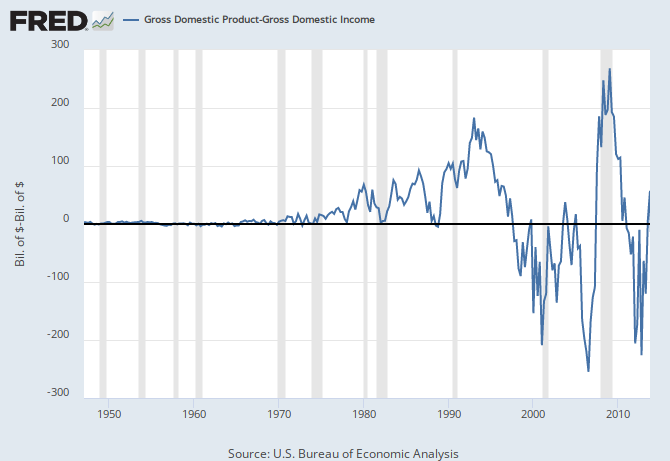
I'll note that I'm less than 100% certain in this diagnosis. The chart isn't in proportional form, and obviously GDP has been growing steadily, especially nominal GDP. So it's possible that, pre-1973, it was fluctuating around zero just as much as it has seemed to be later, as a proportion of the total figure. My sense is that this isn't the case, but without having actual numbers in front of myself I can't be confident in that belief. (Very roughly I think I get that a disparity as large as the -$230 billion or so from around 2005 would've been something like $17 billion in the years before 1970, and the +$180 billion from around 1992 is a bit bigger than that, and it doesn't look like there were any divergences that big, but that's based on eyeballing squiggly lines and thus comes with massive confidence intervals.)
So I think this is yet another extreme example of how 1973 is when everything started going bad, but I'm not completely certain.
Tuesday, March 11, 2014
The Living Constitution, Post-Script: Plessy v. Ferguson Edition
A brief follow-up to my previous post about how no one really believes in the living constitution. Steve Calabresi liked to say, in the class I took with him about constitutional theory, that the first task of any good constitutional theory is to explain why Brown v. Board of Education is correct. Brown is in many ways the center-piece of the modern constitutional understanding and its relationship to society; any theory which views it as erroneous has, therefore, a fatal weakness. But I've often had the thought, especially when reading anything written by Bruce Ackerman but also when reading Jack Balkin's Living Originalism, that this is only half of the test. I don't just want a theory to tell me why Brown is correct. I want it to tell me why Plessy v. Ferguson was wrong. Now, that might sound like the same thing, since the one overturned the other. But I mean that I want a theory to tell my why Plessy has always been wrong, why it was wrong the day it was decided. Partly that's because I believe it was wrong the day it was decided. Partly that's because I think it's important that it was wrong the day it was decided. If we think Brown is right, and that it's important that it's right, which we do, I think it equally important to state clearly that the contrary result could never be the correct one under our Constitution. If Plessy was not really wrong the day it was decided, then the Fourteenth Amendment, which we think of as guaranteeing racial equality, does not really do so, because somehow Plessy was consistent with it, once upon a time.
So I found it very interesting when the article from which I drew the Newtonian-vs.-Darwinian imagery later described the holding of the Brown case thusly:
But I actually think this is a perfect example of my point from my last post. Because, really? Do we really think anyone believed that? That Earl Warren did? That William Brennan did? That they thought the problem with Plessy was just that it had become outdated? I know that the architect of the Brown case, Thurgood Marshall, didn't think Plessy was correct. He was the leader of an organized movement that had been working to undermine and eventually overturn Plessy for more than half of the time between the two cases. Of course he thought Plessy had been wrong the day it was decided. Certainly my grandfather, who defended the Brown case on traditional legal grounds during the controversy it generated, though Plessy had been wrong, and obviously so. Do we really think that Warren, Brennan, Hugo Black, Felix Frankfurter thought that Louisiana's railroad segregation laws of the 1890s were constitutional? I don't think they did. I just don't buy it. I think they all thought that racial segregation was and had always been a denial of the equal protection of the laws.
But that isn't what they said. Instead they couched their opinion in the terms of a living constitution, for some reason. One way or another, they didn't want to condemn the past as strongly as their own opinions would condemn it. Which was arguably a mistake. After all, the living constitution idea, or at least what people usually mean by that phrase, really is a philosophically weak idea. It opens you up to the attack of people like Antonin Scalia and Herbert Weschler, who'll accuse you of judicially rewriting the Constitution. Better to just say, no, the ones who rewrote the Constitution were the Plessy Court, who struck out the Equal Protection Clause from the document. It might make the immediate firestorm worse, as those on the other side castigate you for repudiating their past, but in the long run I think it would lead to a more solid theoretical foundation for the new constitutional understanding.
So I found it very interesting when the article from which I drew the Newtonian-vs.-Darwinian imagery later described the holding of the Brown case thusly:
Not that Plessy v. Ferguson was wrong in 1896, the Court argued, but rather Plessy v. Ferguson had become erroneous because of what separate but equal had come to represent.The Court, in other words, rejected my view. Plessy wasn't wrong at the time, but it became wrong, as the meaning of segregation changed or perhaps as we just grew to understand that meaning better.
But I actually think this is a perfect example of my point from my last post. Because, really? Do we really think anyone believed that? That Earl Warren did? That William Brennan did? That they thought the problem with Plessy was just that it had become outdated? I know that the architect of the Brown case, Thurgood Marshall, didn't think Plessy was correct. He was the leader of an organized movement that had been working to undermine and eventually overturn Plessy for more than half of the time between the two cases. Of course he thought Plessy had been wrong the day it was decided. Certainly my grandfather, who defended the Brown case on traditional legal grounds during the controversy it generated, though Plessy had been wrong, and obviously so. Do we really think that Warren, Brennan, Hugo Black, Felix Frankfurter thought that Louisiana's railroad segregation laws of the 1890s were constitutional? I don't think they did. I just don't buy it. I think they all thought that racial segregation was and had always been a denial of the equal protection of the laws.
But that isn't what they said. Instead they couched their opinion in the terms of a living constitution, for some reason. One way or another, they didn't want to condemn the past as strongly as their own opinions would condemn it. Which was arguably a mistake. After all, the living constitution idea, or at least what people usually mean by that phrase, really is a philosophically weak idea. It opens you up to the attack of people like Antonin Scalia and Herbert Weschler, who'll accuse you of judicially rewriting the Constitution. Better to just say, no, the ones who rewrote the Constitution were the Plessy Court, who struck out the Equal Protection Clause from the document. It might make the immediate firestorm worse, as those on the other side castigate you for repudiating their past, but in the long run I think it would lead to a more solid theoretical foundation for the new constitutional understanding.
Monday, January 27, 2014
The Congress That Wasn't There
Steve Calabresi has, I believe, been known to observe an interesting feature of the U.S. Constitution which, he thinks, reveals something about how the Founders viewed the Executive branch. While Congress is clearly considered the most important of the three branches, hence its placement in the first Article and that Article's length compared to those establishing the Executive and Judiciary, it was only really supposed to exist part of the time. Congress would have a couple of sessions per year, each lasting a couple of months. The rest of the time Congressmen would be at home in their states or districts, and given the state of transportation in 1789 it would be no easy thing to re-assemble Congress when it wasn't in session. When its members were out of town, in other words, Congress basically didn't exist. The President, on the other hand, always existed. He has no sessions and no recess; he's the President for every hour of all 1461 days of his term. The idea, Calabresi would (sensibly, I think) infer, is that the laws always need enforcing, but they don't always need changing. That, after all, is what a legislature does, at any given moment, and if the existing set of laws is working well enough you don't need anyone to do any new legislating all the time. The President can just set about running the government with the authority given him by the current laws. Now, Calabresi goes on to draw various conclusions about the scope of executive authority, I think, but that's not my point here.
No, my point is about what happened to this disparity between the President and Congress over time. Basically, it went away. As transportation has improved, we've reached the point where Congress does basically always exist. They're in session all the time now, except maybe over Christmas. Even when they're in recess, they could reassemble for an important vote with less than a day's notice. This has corresponded with a decline in the sensibility of the "laws don't always need to be changed but they always need to be enforced" point. In 1789, there wasn't that much statutory law. Most of the law was common law. That made the idea that the existing corpus of statutes would be working well enough to get along for a couple of months without any new laws relatively plausible. With the explosion of the regulatory state, a federal code that governs basically everything the Constitution allows federal governance of, and an incredibly complicated feedback process between the administrative agencies, the subjects of their regulation, and Congress, that idea is a lot less plausible now. We need a Congress basically all the time, or at least a Congress that's on call all the time and getting stuff done nearly all of the time.
But while it is a lot less plausible now than it used to be, that old idea hasn't lost all relevance. In fact, the current Congress basically might as well be out of session, back in their districts with a month's journey back to Washington. There is no overlap between the set of non-trivial legislation Barack Obama would sign into law and the set of non-trivial legislation that John Boehner and 217 of his closest friends would pass through the House. More to the point, everyone knows this, except maybe some centrist media types. Even if there are some ideas for new legislation that you'd think would satisfy both parties' agendas, Obama Derangement Syndrome prevents the Republicans from admitting it. So we don't get any new laws. But we have old laws, and Obama gets to administer them. That actually gives him a lot of policy-making authority, which he'll hopefully make major use of this year. That's somewhat different from the 1789 concept, but the similarity is unmistakeable: our government right now consists of an executive branch, a judicial branch, and an extensive legal code, with a legislature which could in theory exists but is currently choosing to act like it doesn't.
Now, no one is exactly happy with the current state of federal statutory law. And Republicans are surely not happy with letting Obama use his authority to enforce such things as new environmental regulations. There are probably things Congress could be doing, major pieces of legislation it could be passing that should be net improvements over this President-and-no-Congress status quo from both parties' perspective. But the Republicans aren't willing to offer Obama anything that he'd find better than the status quo; that's Obama Derangement Syndrome, wherein the simple fact that Obama likes something is sufficient reason for Republicans to dislike it, independent of its actual merits. They keep offering him things that they want but that he doesn't want; given his ability to just keep on takin' care that the laws be faithfully executed, he has absolutely no reason to agree to those things. Thus the era of manufactured crises: every time the status quo expires, every time we actually need new statutory authorization for the government to continue operating, this dynamic vanishes. Obama can't just keep on running the government. In theory, taking away that floor on potential outcomes gives the Republicans the power to get Obama to agree to something he likes worse than the status quo. In practice, Republicans also lose the floor on possible outcomes, and they're not as willing to free-fall into the abyss as they'd like us all to believe, for some reason. Or maybe they're just not willing for us to believe that they're that willing to fall into the abyss.
Either way, it looks like they've finally gotten the message that manufactured crises don't really work. That means we might be in for a whole year or so in which Congress pretends not to exist, and the President is perfectly happy to go along with that pretense.
No, my point is about what happened to this disparity between the President and Congress over time. Basically, it went away. As transportation has improved, we've reached the point where Congress does basically always exist. They're in session all the time now, except maybe over Christmas. Even when they're in recess, they could reassemble for an important vote with less than a day's notice. This has corresponded with a decline in the sensibility of the "laws don't always need to be changed but they always need to be enforced" point. In 1789, there wasn't that much statutory law. Most of the law was common law. That made the idea that the existing corpus of statutes would be working well enough to get along for a couple of months without any new laws relatively plausible. With the explosion of the regulatory state, a federal code that governs basically everything the Constitution allows federal governance of, and an incredibly complicated feedback process between the administrative agencies, the subjects of their regulation, and Congress, that idea is a lot less plausible now. We need a Congress basically all the time, or at least a Congress that's on call all the time and getting stuff done nearly all of the time.
But while it is a lot less plausible now than it used to be, that old idea hasn't lost all relevance. In fact, the current Congress basically might as well be out of session, back in their districts with a month's journey back to Washington. There is no overlap between the set of non-trivial legislation Barack Obama would sign into law and the set of non-trivial legislation that John Boehner and 217 of his closest friends would pass through the House. More to the point, everyone knows this, except maybe some centrist media types. Even if there are some ideas for new legislation that you'd think would satisfy both parties' agendas, Obama Derangement Syndrome prevents the Republicans from admitting it. So we don't get any new laws. But we have old laws, and Obama gets to administer them. That actually gives him a lot of policy-making authority, which he'll hopefully make major use of this year. That's somewhat different from the 1789 concept, but the similarity is unmistakeable: our government right now consists of an executive branch, a judicial branch, and an extensive legal code, with a legislature which could in theory exists but is currently choosing to act like it doesn't.
Now, no one is exactly happy with the current state of federal statutory law. And Republicans are surely not happy with letting Obama use his authority to enforce such things as new environmental regulations. There are probably things Congress could be doing, major pieces of legislation it could be passing that should be net improvements over this President-and-no-Congress status quo from both parties' perspective. But the Republicans aren't willing to offer Obama anything that he'd find better than the status quo; that's Obama Derangement Syndrome, wherein the simple fact that Obama likes something is sufficient reason for Republicans to dislike it, independent of its actual merits. They keep offering him things that they want but that he doesn't want; given his ability to just keep on takin' care that the laws be faithfully executed, he has absolutely no reason to agree to those things. Thus the era of manufactured crises: every time the status quo expires, every time we actually need new statutory authorization for the government to continue operating, this dynamic vanishes. Obama can't just keep on running the government. In theory, taking away that floor on potential outcomes gives the Republicans the power to get Obama to agree to something he likes worse than the status quo. In practice, Republicans also lose the floor on possible outcomes, and they're not as willing to free-fall into the abyss as they'd like us all to believe, for some reason. Or maybe they're just not willing for us to believe that they're that willing to fall into the abyss.
Either way, it looks like they've finally gotten the message that manufactured crises don't really work. That means we might be in for a whole year or so in which Congress pretends not to exist, and the President is perfectly happy to go along with that pretense.
Wednesday, January 15, 2014
Might the Thirteenth Amendment Have Passed Earlier?
Well, no. Obviously not, not as history actually played out. No slave state was ever going to vote for the Thirteenth Amendment (not the real one, anyway, as opposed to the proposed one that would have given slavery constitutional protection for all time), and at no time prior to the Civil War were there ever anything close to enough free states to pass an Amendment all on their own. In fact, once New York and New Jersey abolished slavery the percentage of free states never wavered more than ten percentage points away from 50% in either direction.
So obviously I'm talking about a slightly alternate history. The divergence, I think, wants to start around 1831-32, when Nat Turner's slave rebellion caused many Southern states, most prominently Virginia, to genuinely consider the future of slavery, with some advocating a move toward gradual emancipation. Obviously, that side lost the debate, but what if they had won? Could there have been enough free states and gradual-emancipation states together to pass some sort of anti-slavery amendment without a war?
In 1832, there were twelve slave states and twelve free states. Three-quarters of twenty-four would have been eighteen, so we need six more free states, or at least states perhaps willing to vote for an anti-slavery Amendment. Virginia's one. But let's also say that, had Virginia seriously moved away from slavery, the border states, the ones less Southern than Virginia, would have done so as well. That's Maryland, Delaware, and Kentucky, at the very least. Maybe Missouri as well, and that's up to five, one short of the requirement. This would have made the Missouri Compromise line the line for slavery throughout the country, east as well as west. It also wouldn't quite have been enough for an amendment. If we assume that every state which joined the Union between 1836 and the start of the war would have been aligned as it actually was, this would have been the high point for the prospects of getting the Thirteenth Amendment through ahead of its time.
If, however, Virginia and the border states had rejected the cause of "slavery today, slavery tomorrow, slavery forever" in 1832, the addition of future states might not have happened as it did. Those states probably wouldn't have signed off on national immediate abolition, but they also probably wouldn't have minded admitting more free states and tipping the long-term political balance away from slavery. Perhaps Arkansas might have been admitted as a free state, which would have brought the free or quasi-free states to 72% of the country. Adding Michigan would take that up to 73%, on the eve of the Mexican-American War. But, in this scenario, that war might well not have happened. Or, alternately, prospective free states such as Iowa and Wisconsin might have been admitted before Texas and Florida were added as slave states.
Let's suppose that happened: Arkansas, Michigan, Iowa, and Wisconsin were added to the 1832 mix, with no new slave states. That brings the total to 21 free/quasi-free states, 7 slave states: three-quarters precisely! And in that scenario, those twenty-one states would have been able to band together and pass some sort of compromise, gradual anti-slavery amendment. Perhaps prohibiting the addition of more slave states, prohibiting anyone not currently a slave from being enslaved, rolling back the fugitive slave laws, restricting the slave trade, etc. It wouldn't have been as ringing as the real Thirteenth Amendment, but it might have avoided war and after the phase-out period the practical difference would vanish.
The 1831-32 Virginia slavery debates, in other words, could have been a turning point in American history. Had the other side carried the day, it would have become awfully feasible for the opponents of slavery to achieve a political victory without resorting to a massive, bloody civil war. Now, this alternate Thirteenth Amendment might have triggered war between the seven hold-out slave states and the free majority, but they might have gone along with a sufficiently compromise-laden amendment. Hell, once they saw that the anti-slavery forces were gaining political ascendance they might have been willing to cut a deal on a Thirteenth Amendment that would gradually abolish slavery but on the most lenient terms possible. Plus, had there been a war it would've been over a lot quicker, with only a small handful of relatively small states against the entire rest of the country. American history would be an awfully lot less tragic; the future of civil rights after the abolition of slavery might even have been less of a struggle. Of course, it's probably not a matter of luck that things didn't turn out that way; the pro-slavery side won those debates for a reason, after all. But it's interesting, and a bit heartbreaking, to think about.
So obviously I'm talking about a slightly alternate history. The divergence, I think, wants to start around 1831-32, when Nat Turner's slave rebellion caused many Southern states, most prominently Virginia, to genuinely consider the future of slavery, with some advocating a move toward gradual emancipation. Obviously, that side lost the debate, but what if they had won? Could there have been enough free states and gradual-emancipation states together to pass some sort of anti-slavery amendment without a war?
In 1832, there were twelve slave states and twelve free states. Three-quarters of twenty-four would have been eighteen, so we need six more free states, or at least states perhaps willing to vote for an anti-slavery Amendment. Virginia's one. But let's also say that, had Virginia seriously moved away from slavery, the border states, the ones less Southern than Virginia, would have done so as well. That's Maryland, Delaware, and Kentucky, at the very least. Maybe Missouri as well, and that's up to five, one short of the requirement. This would have made the Missouri Compromise line the line for slavery throughout the country, east as well as west. It also wouldn't quite have been enough for an amendment. If we assume that every state which joined the Union between 1836 and the start of the war would have been aligned as it actually was, this would have been the high point for the prospects of getting the Thirteenth Amendment through ahead of its time.
If, however, Virginia and the border states had rejected the cause of "slavery today, slavery tomorrow, slavery forever" in 1832, the addition of future states might not have happened as it did. Those states probably wouldn't have signed off on national immediate abolition, but they also probably wouldn't have minded admitting more free states and tipping the long-term political balance away from slavery. Perhaps Arkansas might have been admitted as a free state, which would have brought the free or quasi-free states to 72% of the country. Adding Michigan would take that up to 73%, on the eve of the Mexican-American War. But, in this scenario, that war might well not have happened. Or, alternately, prospective free states such as Iowa and Wisconsin might have been admitted before Texas and Florida were added as slave states.
Let's suppose that happened: Arkansas, Michigan, Iowa, and Wisconsin were added to the 1832 mix, with no new slave states. That brings the total to 21 free/quasi-free states, 7 slave states: three-quarters precisely! And in that scenario, those twenty-one states would have been able to band together and pass some sort of compromise, gradual anti-slavery amendment. Perhaps prohibiting the addition of more slave states, prohibiting anyone not currently a slave from being enslaved, rolling back the fugitive slave laws, restricting the slave trade, etc. It wouldn't have been as ringing as the real Thirteenth Amendment, but it might have avoided war and after the phase-out period the practical difference would vanish.
The 1831-32 Virginia slavery debates, in other words, could have been a turning point in American history. Had the other side carried the day, it would have become awfully feasible for the opponents of slavery to achieve a political victory without resorting to a massive, bloody civil war. Now, this alternate Thirteenth Amendment might have triggered war between the seven hold-out slave states and the free majority, but they might have gone along with a sufficiently compromise-laden amendment. Hell, once they saw that the anti-slavery forces were gaining political ascendance they might have been willing to cut a deal on a Thirteenth Amendment that would gradually abolish slavery but on the most lenient terms possible. Plus, had there been a war it would've been over a lot quicker, with only a small handful of relatively small states against the entire rest of the country. American history would be an awfully lot less tragic; the future of civil rights after the abolition of slavery might even have been less of a struggle. Of course, it's probably not a matter of luck that things didn't turn out that way; the pro-slavery side won those debates for a reason, after all. But it's interesting, and a bit heartbreaking, to think about.
Tuesday, January 14, 2014
Why We Abandoned the 14th Amendment
In 1868 the American people ratified the 14th Amendment to the Constitution, which, if you read its text, gave every citizen a broad set of protected constitutional rights and provided every American with a strong guarantee of equality. By 1896 the Amendment was more or less a dead letter, not even prohibiting de jure racial segregation. It had already been robbed of the vast majority of its force long before then, though. In 1883 that broad set of protected rights was held to be essentially trivial in scope. And all the way back in 1873 the Amendment was held not to give Congress the power to directly regulate racial discrimination by private individuals. This is, well, weird. In one sense it's not particularly strange: after all, the America of 1896 or 1873 was in no way ready for true racial equality, or the other kinds of equality the Amendment has since been held to guarantee. But... neither was 1868 America, right? So why did it enact the damn thing in the first place? You'd almost think that something changed between 1868 and 1873. Something big, something that would seriously change our expectations about the American polity's attitudes toward a federal guarantee of individual rights and civil equality.
And you would be right. Something big did happen: we let the South back in. Eleven states joined the Confederacy during the Civil War. Precisely zero Senators or Representatives from those eleven states cast votes on the Fourteenth Amendment, yea or nay. Now, the Southern states did ratify the Amendment, but they were forced to by the all-northern Congress. People have argued that this undermines the legitimacy of the 14th Amendment. I'm not interested in that question here; the point is simply that the Fourteenth Amendment was the product of an entirely northern politics. It was also one of the last things that all-northern politics would ever get to do.
By 1873, every Southern state was back in the Union. In the 1870 census, those states made up almost exactly one quarter of the total population, and a very slightly higher percentage of electoral votes. Their addition meant that the political center of 1873 would have been around the 67th percentile of conservativeness in the 1868 all-northern political culture (assuming the entire South was to the right of that position, which feels safe, on racial issues at least). Or to put it another way, it is entirely possible that there was a genuine strong majority favoring the kind of equality the Fourteenth Amendment seems to establish and that by as early as 1873 that the American people did not want that kind of radical change. Because "the American people" changed in the interim. A political coalition favoring the Fourteenth Amendment's broad principles could easily find itself victorious in 1868 but on shaky footing at best as soon as five years later, hesitant to enforce its own creation for fear of political liability.
In a sense, then, the question is which expression of the will of the people we should treat as dominant, as legitimate. Obviously the normatively correct answer is the 1868 version. That's also why I don't really care about whether the 14th Amendment is formally illegitimate because it was enacted through coercion: as between the cause of racial (and more general) equality and the strictures of the Article V ratification process, I'll take the former every time. Without the Reconstruction Amendments, the U.S. Constitution as a whole would be illegitimate. You could try to argue, though, that we can't treat the text of the Fourteenth Amendment as a true expression of the will of the American people, that the Slaughter-House Cases, Civil Rights Cases, and Plessy v. Ferguson should essentially be retroactively read as the original intent of that Amendment because they represent the attitudes of the country as a whole.
Of course, that entire line of inquiry would depend on giving a damn about the original intent of the American people of 1868. Fortunately, what matters is not what they wanted or thought but what they did, and (except insofar as the 14th Amendment is invalid, which I don't think it is for various reasons) what they did was to guarantee to all the equal protection of the laws, and to protect the privileges and immunities of citizens of the United States. Nice and simple. But if we're puzzled by the fact that We, the People seemed to disavow our own act beginning just half a decade after we made it in the first place, we shouldn't be. We were just a different People.
And you would be right. Something big did happen: we let the South back in. Eleven states joined the Confederacy during the Civil War. Precisely zero Senators or Representatives from those eleven states cast votes on the Fourteenth Amendment, yea or nay. Now, the Southern states did ratify the Amendment, but they were forced to by the all-northern Congress. People have argued that this undermines the legitimacy of the 14th Amendment. I'm not interested in that question here; the point is simply that the Fourteenth Amendment was the product of an entirely northern politics. It was also one of the last things that all-northern politics would ever get to do.
By 1873, every Southern state was back in the Union. In the 1870 census, those states made up almost exactly one quarter of the total population, and a very slightly higher percentage of electoral votes. Their addition meant that the political center of 1873 would have been around the 67th percentile of conservativeness in the 1868 all-northern political culture (assuming the entire South was to the right of that position, which feels safe, on racial issues at least). Or to put it another way, it is entirely possible that there was a genuine strong majority favoring the kind of equality the Fourteenth Amendment seems to establish and that by as early as 1873 that the American people did not want that kind of radical change. Because "the American people" changed in the interim. A political coalition favoring the Fourteenth Amendment's broad principles could easily find itself victorious in 1868 but on shaky footing at best as soon as five years later, hesitant to enforce its own creation for fear of political liability.
In a sense, then, the question is which expression of the will of the people we should treat as dominant, as legitimate. Obviously the normatively correct answer is the 1868 version. That's also why I don't really care about whether the 14th Amendment is formally illegitimate because it was enacted through coercion: as between the cause of racial (and more general) equality and the strictures of the Article V ratification process, I'll take the former every time. Without the Reconstruction Amendments, the U.S. Constitution as a whole would be illegitimate. You could try to argue, though, that we can't treat the text of the Fourteenth Amendment as a true expression of the will of the American people, that the Slaughter-House Cases, Civil Rights Cases, and Plessy v. Ferguson should essentially be retroactively read as the original intent of that Amendment because they represent the attitudes of the country as a whole.
Of course, that entire line of inquiry would depend on giving a damn about the original intent of the American people of 1868. Fortunately, what matters is not what they wanted or thought but what they did, and (except insofar as the 14th Amendment is invalid, which I don't think it is for various reasons) what they did was to guarantee to all the equal protection of the laws, and to protect the privileges and immunities of citizens of the United States. Nice and simple. But if we're puzzled by the fact that We, the People seemed to disavow our own act beginning just half a decade after we made it in the first place, we shouldn't be. We were just a different People.
Saturday, November 16, 2013
Since When Is Saving So Virtuous?
I happen to be watching an episode of Doctor Who set in Victorian England, which features a number of lines about "Victorian values," having already today read a Paul Krugman post that mentioned, in passing, the desire of some people for the economy to be a "morality play" where virtuous, hard-working, thrifty savers are rewarded and those who live beyond their means are punished, both at an individual and a national level. The confluence of the two has me thinking: who said saving money is so virtuous? Obviously there's the actual economic policy question. Under conditions of full employment, saving is good because it leads to investment, and investment drives the course of long-term growth, which is good. But when there's excess capacity in the economy, increased individual savings, which must take the form of decreased individual consumption, reduces overall national income, perhaps quite a lot, and can even end up reducing the amount of investment, all of which is bad.
But what is this sense, this pretty clearly deontological sense, in which people want, viscerally, to insist that saving is virtuous, and that therefore the second half of that policy analysis must be wrong? Maybe it's not so mystifying: after all, saving money means foregoing consumption, and consumption is a form of self-indulgence. Consumption is then un-virtuous for the same basic reason that sex is: it's fun. But here's the thing: you aren't deprived of any asset to have sex. Economic consumption, on the other hand, is a trade of money for something other than money, usually something which you just enjoy for a while and that then disappears into the sands of time. So when I decide to consume something, yes I'm indulging myself but I'm also losing money, and that money goes somewhere. It goes to someone other than me. If instead I decide to save, I just keep the money for myself. In the long run, then, individuals who save more appropriate more of the world's resources for themselves, or more to the point they appropriate a larger share of the power to command the world's resources for themselves, holding employment and income constant. What's so selfless or virtuous about that? It's like a dragon, hoarding gold in its cavern. Now, of course, it isn't like that at all, because you lend the money out to fund investments and the like, but that just takes us back out of the deontology into the policy considerations of my first paragraph.
If, therefore, we forget about secondary economic effects, it's not at all clear why we should think that saving money rather than spending it on consumption is virtuous. If you spend the money you earn, it doesn't stay locked up with you, but rather gets spread back out throughout the economy. Yes, the people who receive your money had to produce something for you to consume to get it, but assuming basic economic principles are right, it cost them less to produce the stuff than you paid them for it, so they come out ahead. Yes, you get to consume the stuff, but at the expense of your own long-term wealth. That sounds like generosity to me, not as much generosity as if you just gave the money away in exchange for nothing more than the satisfaction of improving someone else's life. But in a world of peasants and misers, every peasant would prefer that the misers spend some of their money buying stuff from the peasants. (Again, that's excluding the whole "investment makes everyone better in the long run" thing.) It requires, therefore, the invention of an economic ideology of considerable force in order to make those misers seem like the good guys, the people who morally deserve to be rewarded for their great virtue and self-sacrifice. They're not sacrificing short-term consumption for their own long-term wealth, they're sacrificing it for the long-term good of the whole society.
And in many ways that's true, except that (a) there's just a limit on how much money you can spend on consumption that will actually make your life meaningfully better, so when a rich person saves money they're not really sacrificing much, and (b) as soon as aggregate demand stops meeting aggregate supply, the whole thing falls apart and the virtuous economic effects of saving become vicious instead. The basic point, though, is that we most definitely shouldn't let any notion of "saving = virtue," separate from serious economic analysis about the practical effects of savings on the whole economy, infect our thinking, since that notion can only arise in the first place out of a serious though partial such analysis. Sometimes it is true that lower levels of individual consumption and higher levels of individual savings are a good thing, but this is in a sense the exception, not the rule Consumption is of immediate benefit for both the consumer and the producer. It is not, therefore, perverse for increased consumption and reduced savings to be a good thing; in a sense the opposite is the perverse condition, which only ever attains because of a particular mechanism within a particular economic state of affairs. We should be grateful for that perverse condition, since it has been responsible for much of modern prosperity, but this should not confuse us into forgetting that it is an artificial creation of the modern capitalist economy, not some inherent natural state of the world.
But what is this sense, this pretty clearly deontological sense, in which people want, viscerally, to insist that saving is virtuous, and that therefore the second half of that policy analysis must be wrong? Maybe it's not so mystifying: after all, saving money means foregoing consumption, and consumption is a form of self-indulgence. Consumption is then un-virtuous for the same basic reason that sex is: it's fun. But here's the thing: you aren't deprived of any asset to have sex. Economic consumption, on the other hand, is a trade of money for something other than money, usually something which you just enjoy for a while and that then disappears into the sands of time. So when I decide to consume something, yes I'm indulging myself but I'm also losing money, and that money goes somewhere. It goes to someone other than me. If instead I decide to save, I just keep the money for myself. In the long run, then, individuals who save more appropriate more of the world's resources for themselves, or more to the point they appropriate a larger share of the power to command the world's resources for themselves, holding employment and income constant. What's so selfless or virtuous about that? It's like a dragon, hoarding gold in its cavern. Now, of course, it isn't like that at all, because you lend the money out to fund investments and the like, but that just takes us back out of the deontology into the policy considerations of my first paragraph.
If, therefore, we forget about secondary economic effects, it's not at all clear why we should think that saving money rather than spending it on consumption is virtuous. If you spend the money you earn, it doesn't stay locked up with you, but rather gets spread back out throughout the economy. Yes, the people who receive your money had to produce something for you to consume to get it, but assuming basic economic principles are right, it cost them less to produce the stuff than you paid them for it, so they come out ahead. Yes, you get to consume the stuff, but at the expense of your own long-term wealth. That sounds like generosity to me, not as much generosity as if you just gave the money away in exchange for nothing more than the satisfaction of improving someone else's life. But in a world of peasants and misers, every peasant would prefer that the misers spend some of their money buying stuff from the peasants. (Again, that's excluding the whole "investment makes everyone better in the long run" thing.) It requires, therefore, the invention of an economic ideology of considerable force in order to make those misers seem like the good guys, the people who morally deserve to be rewarded for their great virtue and self-sacrifice. They're not sacrificing short-term consumption for their own long-term wealth, they're sacrificing it for the long-term good of the whole society.
And in many ways that's true, except that (a) there's just a limit on how much money you can spend on consumption that will actually make your life meaningfully better, so when a rich person saves money they're not really sacrificing much, and (b) as soon as aggregate demand stops meeting aggregate supply, the whole thing falls apart and the virtuous economic effects of saving become vicious instead. The basic point, though, is that we most definitely shouldn't let any notion of "saving = virtue," separate from serious economic analysis about the practical effects of savings on the whole economy, infect our thinking, since that notion can only arise in the first place out of a serious though partial such analysis. Sometimes it is true that lower levels of individual consumption and higher levels of individual savings are a good thing, but this is in a sense the exception, not the rule Consumption is of immediate benefit for both the consumer and the producer. It is not, therefore, perverse for increased consumption and reduced savings to be a good thing; in a sense the opposite is the perverse condition, which only ever attains because of a particular mechanism within a particular economic state of affairs. We should be grateful for that perverse condition, since it has been responsible for much of modern prosperity, but this should not confuse us into forgetting that it is an artificial creation of the modern capitalist economy, not some inherent natural state of the world.
Tuesday, November 12, 2013
Nope, Sorry, Supreme Court Justices Aren't Staying on the Bench Longer
This is not the post I expected to write. I expected to write a post offering an alternate interpretation of the statistics in this Slate post advocating an attack on life tenure for federal judges. Basically, they present data showing that more Justices are staying on the Court at least 10, 20, and 30 years since 1900 than did so before that year. My argument was going to be that this wasn't necessarily because the Justices were living longer, but just that the Supreme Court has come to be seen as a more important institution, basically as constitutional law and individual-rights law have grown to their current prominence, and so fewer Justices were just leaving to go do something better. I was going to claim that you could see this in the massive increase of 10-year Justices, and the proportionally similar growth of 20-year ones, and the complete lack of an increase in 30-year Justices. But, as it happens, I'm not going to write that post. Because while I was writing that post I discovered that I couldn't generate their numbers for myself, by looking at the very-publicly-available and not-very-complicated data. In fact they don't state very explicitly how they're getting their numbers, and I can make one assumption that gets me numbers close to theirs, though not the very same numbers. But that's not really my point, I don't care much about whether someone writing a Slate post got slightly wrong how long the various Justices have been in office. No, my point is that my own look at the data suggests that their factual conclusion is just wrong: there has been no long-term trend toward longer terms in office among Supreme Court Justices, though there's some reason to think the current Court might be beginning to exhibit one. The data here is really tricky, but I'll go through it in some detail below the jump.
Sunday, November 3, 2013
When Legal Realism Gets Internalized
Back in the old days, common law judges had what we would now consider a naively romantic view of their jobs. They did not see themselves as making the law, but rather as using the principles of Reason to "discover" the law. The law, they thought, had external validity. It just existed, out there, somewhere, sort of as natural law was thought to. Some of them might even have said that the common law they applied was natural law, though others might have denied it. Then, starting a little more than a century ago in this country, came the legal realists, who basically demolished this idea. They pointed out, irrefutably so, that an awful lot of judicial decision-making was influenced by the personal characteristics of individual jurists, the politics, the identities, the ideologies, etc. That was the empirical claim. It got kind of wrapped up in a philosophical claim about what law is. To a legal realist the idea of the law's existing independently of the legal system was absurd. Put perhaps a bit too concisely, the law was seen as nothing more than a prediction about the behavior of judges.
This story, of the rise of legal realism and the corresponding fall, and then demise, of the classical view of law, kept occurring to me earlier tonight as I read the line of Supreme Court cases about federal common law. Here the story is as follows: in Swift v. Tyson (1842), Justice Joseph Story declared that, in a case which only gets into federal court because the parties to it are from different states, i.e. where the legal issues are not ones of federal but rather of state law, the federal courts were not bound to follow state common law. Part of the motivation may have been the desire to create a uniform national commercial law through the federal common law. In any event, this was the rule for very nearly a century, until the Court overturned Swift in Erie Railroad Co. v. Tompkins (1938). And I just couldn't shake the feeling that the difference between the two cases is the difference between classicism and realism. Moreover, though I'm not at all sure which of the two cases I think is better, it seems to me that Erie and its progeny showcase the potential dangers of letting the legal system internalize even the most valid insights of the legal realists.
This story, of the rise of legal realism and the corresponding fall, and then demise, of the classical view of law, kept occurring to me earlier tonight as I read the line of Supreme Court cases about federal common law. Here the story is as follows: in Swift v. Tyson (1842), Justice Joseph Story declared that, in a case which only gets into federal court because the parties to it are from different states, i.e. where the legal issues are not ones of federal but rather of state law, the federal courts were not bound to follow state common law. Part of the motivation may have been the desire to create a uniform national commercial law through the federal common law. In any event, this was the rule for very nearly a century, until the Court overturned Swift in Erie Railroad Co. v. Tompkins (1938). And I just couldn't shake the feeling that the difference between the two cases is the difference between classicism and realism. Moreover, though I'm not at all sure which of the two cases I think is better, it seems to me that Erie and its progeny showcase the potential dangers of letting the legal system internalize even the most valid insights of the legal realists.
Saturday, July 6, 2013
Perhaps the Founders Would Be Disappointed. So What?
Gallup apparently has a habit of asking, on one of its late-July polls, whether the respondents believe that "the signers of the Declaration of Independence would be pleased or disappointed by the way the United States turned out." They asked this for the Fourth of July in 1999, when 55% to 44% the public believed the Founding Fathers would be disappointed. Then there was a little surge of, I dunno, patriotism? Something, anyway, because when they asked it during the summer of 2001 (note that this is prior to September of 2001, so this wasn't a rally-'round-the-flag thing) the numbers had flipped: 54% to 42%. The bounce receded a bit by 2003, with a 50%/48% split in favor of "pleased."
Well, all that's changed now: just 27% think they'd be pleased, while 71% think they'd be disappointed.
I have two comments to make about these numbers, one short and one long. First, the short one: while I understand it on a psychological level, on any rational level it is insane for the numbers to have changed that much over the last decade. Right now we're in an economic slump, sure. That has astoundingly little to do with how the country has turned out when we're talking about 250 years! I suppose some of the stuff about intractable war has become more obvious in that time, and I guess if you're a right-winger you've probably gone all Clarence Thomas on the entire Obama Presidency. But, c'mon, in both of those dimensions honestly, from where we were in 1776 we were at least 90% or 95% of the way, ten years ago, to where we are now. The country just isn't that different from its 2001 version, compared to the mutual differences to the early Republic. If you think the tipping-point was in that particular decade, well, I'd be curious to hear you defend it.
Now the long one: I'm in the 71%. I think the vast majority of the Founders would be kind of livid if they were taken on a TARDIS trip from July 4th, 1776 to July 4th, 2013. Part of the reason why is that you have a lot of different changes, each with the potential to alienate a different Founding-era constituency. Any founder particularly wedded to the idea of America as a uniformly Protestant, or even just Christian, or even just religious nation would be disappointed. Any founder particularly uncomfortable with the idea of, you know, gay people--and let's be honest, that's essentially all of 'em!--would be disappointed. Thomas Jefferson's dream of an agrarian republic? Crashed and burned. And then, of course, there's the whole contingent who were committed to the supremacy and superiority of the white race, and the larger contingent who were committed to the political supremacy of the male sex. They're both in for a shock. (Of course, some of their wives and slaves might like what they would see in 2013, but none of them signed the Declaration.)
There may be other, subtler issues that would cause some to be disappointed. Yes, many of them probably wouldn't like how powerful the federal government has become, or that we have standing armies now, or that the practice of corporal punishment of children has gone mostly out of fashion. Or whatever. And psychologically, my guess is that finding one big change that a given Founder thought was a big negative would be enough to put that guy squarely in the Disappointed camp. Some might be judicious enough to say, okay, that's not how I envisioned it, but it looks like a nice place altogether, prosperous and free overall, and maybe my vision of the future didn't do so bad, not compared to all the hardline pro-slavery guys anyway. And honestly I think Alexander Hamilton would just plain love it. But most of them, I think, would find something to hate in how the future panned out, so I think it definitely true that most of them would consider themselves Disappointed.
But, guess what? They'd be wrong! All of those changes that they would be disappointed in? They were great! Racial and gender equality is awesome! Sexual liberation is awesome! Cities are awesome! Religion is not awesome! (Okay, I guess if you're particularly religious you might not be with me on that point...) And, you know what? All you conservatives who love to talk about how the Obama Administration is betraying the Founders' ideal of limited government? If Paul Ryan's budget were passed into law tomorrow, it would be a rounding error on the tally of how far the federal government's powers have been enlarged since 1789. You wouldn't be able to tell the difference. Among other things, as the Founders probably knew much better than modern "constitutional conservatives," big spending maketh not big government, and spending cuts don't fight tyranny. If you repealed the Social Security Act of 1935 and all subsequent amendments and additions thereto, you'd change the dynamic of federal power, but last I checked the Republican Party is firmly against that course of action, which means that all those conservatives are positively thrilled that we've expanded the federal government way beyond what the Founders envisioned. They just think, of course, that we went too far a couple years back. (Though of course, they're the ones happiest about something the Founders really thought was a sign of tyrannical government, namely our marvelous modern standing army.)
Really, there's only one way in which America, 2013 is substantially worse than America, 1776: our environment has spent the intervening 237 years being degraded with a vengeance, and in ways whose full devastating impact will not be fully known for another century. Other than that, all the myriad massive changes which have swept through this nation and the entire world which the people of 1776 could not have envisioned and probably would not have liked the thought of had they known they were coming have been for the better. We are a nation larger, more populous, more prosperous, more powerful, more cohesive, more egalitarian, more democratic, and, I think, freer than any reasonable extrapolation from 1776 could have foreseen. And if the Founders don't like it, they're free to spin around in their graves all they like.
(Except Alexander Hamilton, though. Seriously, that dude was awesome, and way ahead of his time. He'd feel right at home now.)
Well, all that's changed now: just 27% think they'd be pleased, while 71% think they'd be disappointed.
I have two comments to make about these numbers, one short and one long. First, the short one: while I understand it on a psychological level, on any rational level it is insane for the numbers to have changed that much over the last decade. Right now we're in an economic slump, sure. That has astoundingly little to do with how the country has turned out when we're talking about 250 years! I suppose some of the stuff about intractable war has become more obvious in that time, and I guess if you're a right-winger you've probably gone all Clarence Thomas on the entire Obama Presidency. But, c'mon, in both of those dimensions honestly, from where we were in 1776 we were at least 90% or 95% of the way, ten years ago, to where we are now. The country just isn't that different from its 2001 version, compared to the mutual differences to the early Republic. If you think the tipping-point was in that particular decade, well, I'd be curious to hear you defend it.
Now the long one: I'm in the 71%. I think the vast majority of the Founders would be kind of livid if they were taken on a TARDIS trip from July 4th, 1776 to July 4th, 2013. Part of the reason why is that you have a lot of different changes, each with the potential to alienate a different Founding-era constituency. Any founder particularly wedded to the idea of America as a uniformly Protestant, or even just Christian, or even just religious nation would be disappointed. Any founder particularly uncomfortable with the idea of, you know, gay people--and let's be honest, that's essentially all of 'em!--would be disappointed. Thomas Jefferson's dream of an agrarian republic? Crashed and burned. And then, of course, there's the whole contingent who were committed to the supremacy and superiority of the white race, and the larger contingent who were committed to the political supremacy of the male sex. They're both in for a shock. (Of course, some of their wives and slaves might like what they would see in 2013, but none of them signed the Declaration.)
There may be other, subtler issues that would cause some to be disappointed. Yes, many of them probably wouldn't like how powerful the federal government has become, or that we have standing armies now, or that the practice of corporal punishment of children has gone mostly out of fashion. Or whatever. And psychologically, my guess is that finding one big change that a given Founder thought was a big negative would be enough to put that guy squarely in the Disappointed camp. Some might be judicious enough to say, okay, that's not how I envisioned it, but it looks like a nice place altogether, prosperous and free overall, and maybe my vision of the future didn't do so bad, not compared to all the hardline pro-slavery guys anyway. And honestly I think Alexander Hamilton would just plain love it. But most of them, I think, would find something to hate in how the future panned out, so I think it definitely true that most of them would consider themselves Disappointed.
But, guess what? They'd be wrong! All of those changes that they would be disappointed in? They were great! Racial and gender equality is awesome! Sexual liberation is awesome! Cities are awesome! Religion is not awesome! (Okay, I guess if you're particularly religious you might not be with me on that point...) And, you know what? All you conservatives who love to talk about how the Obama Administration is betraying the Founders' ideal of limited government? If Paul Ryan's budget were passed into law tomorrow, it would be a rounding error on the tally of how far the federal government's powers have been enlarged since 1789. You wouldn't be able to tell the difference. Among other things, as the Founders probably knew much better than modern "constitutional conservatives," big spending maketh not big government, and spending cuts don't fight tyranny. If you repealed the Social Security Act of 1935 and all subsequent amendments and additions thereto, you'd change the dynamic of federal power, but last I checked the Republican Party is firmly against that course of action, which means that all those conservatives are positively thrilled that we've expanded the federal government way beyond what the Founders envisioned. They just think, of course, that we went too far a couple years back. (Though of course, they're the ones happiest about something the Founders really thought was a sign of tyrannical government, namely our marvelous modern standing army.)
Really, there's only one way in which America, 2013 is substantially worse than America, 1776: our environment has spent the intervening 237 years being degraded with a vengeance, and in ways whose full devastating impact will not be fully known for another century. Other than that, all the myriad massive changes which have swept through this nation and the entire world which the people of 1776 could not have envisioned and probably would not have liked the thought of had they known they were coming have been for the better. We are a nation larger, more populous, more prosperous, more powerful, more cohesive, more egalitarian, more democratic, and, I think, freer than any reasonable extrapolation from 1776 could have foreseen. And if the Founders don't like it, they're free to spin around in their graves all they like.
(Except Alexander Hamilton, though. Seriously, that dude was awesome, and way ahead of his time. He'd feel right at home now.)
Sunday, March 17, 2013
Arbitrary and Capricious, Eighteenth-Century Style
I'm doing some reading for my British History class about the criminal "justice" system in England in the 1700s. Apparently, during that century Parliament passed an awful lot of new laws authorizing capital punishment for various offenses against property. However, the number of actual executions for crimes against property didn't increase much at all, even as the number of convictions for capital crimes against property did. Why? Because an awful lot of death sentences got commuted by royal prerogative into exile to, say, Australia. This happened on the recommendation of judges, and apparently the very same MPs passing the death penalty statutes were often the ones intervening to secure clemency. This seems like a bit of a puzzle, at first, but given the discussion of capital punishment in the contemporary era, and particularly my grandfather's book on the subject, there's a pretty obvious answer that occurs to me. When you have a lot of people getting convicted of capital crimes, most of whom don't actually get executed, it gives the people deciding to whom the pardons will be doled out a tremendous amount of arbitrary and capricious power. It's sort of analogous to what happens if you create a legal code in which just about everyone will be guilty of some minor offense, jaywalking, say, or something perhaps slightly less minor but equally routine, but where as a rule no one is prosecuted. That gives the authorities the ability to selectively enforce those laws against people they don't like, for one reason or another: political enemies, say, or more serious criminals they can't get on the main charges of murder, theft, whatever. And if you just look at the convictions, or in the 18th-century Britain case if you just look at the executions, you won't see anything wrong with the procedure: the people in question were guilty under law of committing crimes, and were punished accordingly. You only notice a problem when you see all of the people equally guilty not being punished, and start to wonder why some got away with their crimes while some had the book thrown at them.
Monday, February 4, 2013
The Passionate Society
My current reading material for my Classics of Political Economy course is The Passions and the Interests by Albert Hirschman. The part I've been reading consists mainly of a survey or summary of the treatment of passions in mainstream philosophy from the very early says of Saint Augustine through (with a bit of a skimming over the Dark Ages) the eighteenth century. At least, that's as far as I've gone so far. And the thing I find really striking is that it is the almost unanimous opinion of the thinkers Hirschman has quoted that passions are bad. Augustine, for instance, defined three kinds of lust, namely sexual lust, lust for money/possessions, and lust for power, and, obviously, thought they were all sinful and bad. That continued to be the position of the more-or-less religious segments of the philosophical community until, well, the present day, really. Opposition to that view, that all passions are bad and people should abstain from indulging them because they're bad and people should want to be good, came from people who said, wait a minute, that's not realistic. Instead of just telling people their passions are bad, which won't work (even though it's true), let's try to discover which passions are less bad, and use them to control the others. For instance, David Hume is said by this author to have advocated restraining the "love of pleasure" through the "love of gain."
Now, when I read that sentence, my immediate thought was that it was simply insane. What's wrong with the love of pleasure? Pleasure is great! Almost by definition! It doesn't get much better than pleasure. If people were on the whole more devoted to pursuing pleasure, and less to pursuing gain, everyone's lives would probably be better. Sure, it would pose problems for our particular economic structures, but as the world gets more and more prosperous that becomes less and less of a problem, as seen in the general trend toward more leisure time. That's a straight-up gain-for-pleasure trade, and I think it a most sensible one. After all, what's the point of gaining stuff if not enjoying it? And if the point of gaining stuff is to enjoy it, why try to gain stuff if you could be doing other stuff that was more enjoyable than having the stuff would be? Now, stuff is nice, and can lead to lots of pleasure, so a pure love-of-pleasure agenda wouldn't exterminate the acquisitive interest, but on a very basic level it seems to me that Hume had it backwards.
But I think that's just emblematic of my broader point in this post, which is that the view that passions are bad has lost. Though I'm sure a lot of lingering religious institutions don't like this fact, it is unquestionably true that in modern Western society, people accept as a matter of fact that passions are basically good. We don't deny that they can have problematic consequences, and that one should avoid acting on one's passions if doing so will have problematic consequences, but fundamentally we just don't view the suppression of passions as an end in itself. Rather, we view the expression of passions as an end in itself, possibly the main point of life and at least one of the main ones. We live in the passionate society. The reading I'm currently doing is largely devoted to examining how the passion for material acquisition made the switch from being Bad to Good. Of, I think, at least equal importance and magnitude is the transformation in attitudes toward sexual and romantic passion. The passion for power is a somewhat different animal in the modern world than it was in the time periods I've just been reading about; for one thing, it's a lot less possible for one random person to gain meaningful political power except by holding office in the government of a nation-state, and for another, economic power becomes ever more important leading this passion to dovetail with the material-acquisition passion to ever-greater degrees. But even in the life of the American republic there has been a shift in attitudes toward political ambition. In the olden days, it was taboo to actively campaign for President. Yeah. 'Nuff said.
What I think is behind all of this is the basic hegemony of more-or-less utilitarian ethics. That's a very loaded word that means an awful lot of things, most of which I don't mean in this context, but what I do mean is that teleological and deontological ethics have become massively less influential over the past couple of centuries. Perhaps the best term for their competitor is consequentialist, but what really separates these kinds of ethics isn't their form. After all, one can express achieving one's telos as a consequence, and perform a pseudo-consequentialist calculus that will effect a teleological ethics, or express a pseudo-deontological ethical rule saying "don't harm other people" that would effect a consequentialist ethics. The difference is almost entirely that in consequentialist ethics, "good" is treated as almost synonymous with "advancing the interests of beings" for some class of beings and some class of interests. And the interests are typically things like pleasure or utility or happiness. Again, you can bend that structure back toward one of the old-fashioned kinds of ethics, but in practice people don't. Something is good if it makes people happy. Something is bad if it makes people sad. In that world, passions are the basic thing we're trying to satisfy. If two people meet up in a bar and go off to a hotel and have sex, and both enjoy the experience a lot, and then go their separate ways by mutual consent, that's great! They've both just satisfied their passions, and good for them. We only really discover "bad" when one person's passion interferes with another's.
Obviously I think this was a change for the better. But then I would: I'm a proud citizen of the passionate society. Good or bad, however, I do think that this wholesale shift in our society's philosophy of ethics and desire and pleasure is really interesting. I'll close this philosophical musing with a few lines from that great thinker, Angelus:
Now, when I read that sentence, my immediate thought was that it was simply insane. What's wrong with the love of pleasure? Pleasure is great! Almost by definition! It doesn't get much better than pleasure. If people were on the whole more devoted to pursuing pleasure, and less to pursuing gain, everyone's lives would probably be better. Sure, it would pose problems for our particular economic structures, but as the world gets more and more prosperous that becomes less and less of a problem, as seen in the general trend toward more leisure time. That's a straight-up gain-for-pleasure trade, and I think it a most sensible one. After all, what's the point of gaining stuff if not enjoying it? And if the point of gaining stuff is to enjoy it, why try to gain stuff if you could be doing other stuff that was more enjoyable than having the stuff would be? Now, stuff is nice, and can lead to lots of pleasure, so a pure love-of-pleasure agenda wouldn't exterminate the acquisitive interest, but on a very basic level it seems to me that Hume had it backwards.
But I think that's just emblematic of my broader point in this post, which is that the view that passions are bad has lost. Though I'm sure a lot of lingering religious institutions don't like this fact, it is unquestionably true that in modern Western society, people accept as a matter of fact that passions are basically good. We don't deny that they can have problematic consequences, and that one should avoid acting on one's passions if doing so will have problematic consequences, but fundamentally we just don't view the suppression of passions as an end in itself. Rather, we view the expression of passions as an end in itself, possibly the main point of life and at least one of the main ones. We live in the passionate society. The reading I'm currently doing is largely devoted to examining how the passion for material acquisition made the switch from being Bad to Good. Of, I think, at least equal importance and magnitude is the transformation in attitudes toward sexual and romantic passion. The passion for power is a somewhat different animal in the modern world than it was in the time periods I've just been reading about; for one thing, it's a lot less possible for one random person to gain meaningful political power except by holding office in the government of a nation-state, and for another, economic power becomes ever more important leading this passion to dovetail with the material-acquisition passion to ever-greater degrees. But even in the life of the American republic there has been a shift in attitudes toward political ambition. In the olden days, it was taboo to actively campaign for President. Yeah. 'Nuff said.
What I think is behind all of this is the basic hegemony of more-or-less utilitarian ethics. That's a very loaded word that means an awful lot of things, most of which I don't mean in this context, but what I do mean is that teleological and deontological ethics have become massively less influential over the past couple of centuries. Perhaps the best term for their competitor is consequentialist, but what really separates these kinds of ethics isn't their form. After all, one can express achieving one's telos as a consequence, and perform a pseudo-consequentialist calculus that will effect a teleological ethics, or express a pseudo-deontological ethical rule saying "don't harm other people" that would effect a consequentialist ethics. The difference is almost entirely that in consequentialist ethics, "good" is treated as almost synonymous with "advancing the interests of beings" for some class of beings and some class of interests. And the interests are typically things like pleasure or utility or happiness. Again, you can bend that structure back toward one of the old-fashioned kinds of ethics, but in practice people don't. Something is good if it makes people happy. Something is bad if it makes people sad. In that world, passions are the basic thing we're trying to satisfy. If two people meet up in a bar and go off to a hotel and have sex, and both enjoy the experience a lot, and then go their separate ways by mutual consent, that's great! They've both just satisfied their passions, and good for them. We only really discover "bad" when one person's passion interferes with another's.
Obviously I think this was a change for the better. But then I would: I'm a proud citizen of the passionate society. Good or bad, however, I do think that this wholesale shift in our society's philosophy of ethics and desire and pleasure is really interesting. I'll close this philosophical musing with a few lines from that great thinker, Angelus:
Passion. It lies in all of us, sleeping, waiting, and though unwanted, unbidden, it will stir, open its jaws, and howl. It speaks to all of us, guides us. Passion rules us all, and we obey. What choice do we have? Passion is the source of our finest moments. The joy of love, the clarity of hatred... and the ecstacy of grief. It hurts sometimes more than we can bear. If we could live without passion, maybe we'd know some kind of peace. But we would be hollow. Empty rooms, shuttered and dark. Without passion, we'd be truly dead.
Thursday, January 31, 2013
Well, I Suppose That's One Way to Look At It
Here's a passage from the article I'm currently reading on political thought during the Restoration Monarchy in Britain from the 1660s to the 1680s:
"The clinching argument [for the Tories] that sovereign authority must be God-given was that rulers had the right of capital punishment. Since the Commandment enjoins, 'Thou shalt not kill', the right to take life could not have been transferred by the consent of the people, for it was not a right that the people had to give."That's... an interesting argument, seventeenth-century Tories. Observing that your religion says killing is wrong, and that your kings possess the power of capital punishment, your conclusion is not that this royal power conflicts with the relevant Commandment and is therefore wrong, but that this is evidence that the kings have a kind of quasi-divine status that exempts them from the Commandment. Interesting.
Saturday, November 3, 2012
The Smallest Winning Map Ever
A few days ago, Matt Yglesias put up a blog post in which he came up with the smallest possible winning electoral college map under the current vote distribution. He calculated this by sorting the 51 voting areas (i.e., states plus D.C.) in descending order by population density, and tacking states onto the map in that order until he had 270 electoral votes. D.C. was first, obviously, followed by New Jersey and then various other states. In the end he got a map with 627,421 square miles making up exactly 270 electoral votes and beating out the 268 electoral votes of the other 3,166,662 square miles of the country, just 16.5% of the country's land mass constituting a winning coalition. Actually, Alaska all by itself is bigger than these states which constitute an electoral majority. It's a majority of the people, though, with 166,439,539 living in the Yglesias victor states against just 142,306,179 in the losing states. That's a population density of 265.3 people per square mile in the winning states, and 44.9 people per square mile in the losing states.
Okay, cool. But the American population is a good deal less clustered in the Northeast than it used to be, so I got to wondering whether the smallest winning map might have been even smaller in the past. Using the 1960 census apportionment figures, i.e. the first batch after the addition of Alaska and Hawaii, I was able to craft an even smaller winning map:
 Those blue states take up just 559,605 square miles, with 3,234,478 square miles of red territory, and an exact 270-268 electoral margin. My calculation method was a bit different from Yglesias'; instead of calculating 1960 census population density, I simply calculated electoral vote population density, and added until I hit 270. California was the tipping-point state, and since it got me to 284 EV's, South Carolina and West Virginia, only slightly more vote-dense than California, were superfluous. Incidentally, using this same method for the 2010 figures got me to the same map as Yglesias, though through a slightly different method. Whereas he added on the densest states until he hit Michigan, and then had 282 EV's, took Michigan back out to get down to 266, and added on New Hampshire to hit 270, I added on the most vote-dense states until I hit North Carolina, which got me to 282 EVs, and then subtracted off South Carolina (9) and Vermont (3). Somewhat confusingly, it doesn't look to me like Michigan is even in consideration; unless I'm really missing something, it is not, as he says, the 18th most densely populated state.
That's as far back as you can go, obviously, with Alaska and Hawaii still included, and since one of those two states in particular changes the geographic footprint of this country quite substantially the direct comparisons sort of end there. But just for fun, let's also look at the figures using the 1920 census apportionment, the first after all 48 continental states were added to the rolls. Here, we can get 268 electoral votes (enough to win, since there were only 531) with just 481,569 square miles, with 2,638,247 square miles taking the other 263 votes (the total is smaller, because we're missing Alaska):
 Frustratingly, if you swapped out South Carolina and Virginia for Missouri, which would remove a bit more than 5000 square miles, you'd end up with 265 electoral votes in the blue states, and 266 in the red states. So I think this is probably the smallest possible winning electoral map since the continental United States got itself filled out. For whatever that's worth.
Okay, cool. But the American population is a good deal less clustered in the Northeast than it used to be, so I got to wondering whether the smallest winning map might have been even smaller in the past. Using the 1960 census apportionment figures, i.e. the first batch after the addition of Alaska and Hawaii, I was able to craft an even smaller winning map:

That's as far back as you can go, obviously, with Alaska and Hawaii still included, and since one of those two states in particular changes the geographic footprint of this country quite substantially the direct comparisons sort of end there. But just for fun, let's also look at the figures using the 1920 census apportionment, the first after all 48 continental states were added to the rolls. Here, we can get 268 electoral votes (enough to win, since there were only 531) with just 481,569 square miles, with 2,638,247 square miles taking the other 263 votes (the total is smaller, because we're missing Alaska):

Thursday, October 4, 2012
The Greatly-Leveraged Man Theory of History
I am currently taking a course on English history from 1529 to 1660 (approximately), and one of the main focuses has been on the path of the English Reformation. Right now I'm doing some research for an essay on that topic, in particular by reading about the Reformations in other European countries as points of comparison. And the overall impression I get is that, by and large, the political disposition of a given country followed the inclination of that country's monarch. There are exceptions: Protestantism flourishing in Scotland under Mary Stewart's reign and surviving in England through the bloody years of Mary Tudor, and conversely failing in Ireland despite having the support of the English overlords. But by and large it seems that the personal inclination of the actual monarch played an enormous role in determining the religious fate of each country, that just about everyone in 16th century Europe knew this, and that the exceptions to the rule tend to feature pretty substantial countervailing dynamics (e.g., in Ireland Protestantism became associated with conquest and imperialism, Catholicism with nationalism and resistance).
Now, saying things like this, or for example "the English Reformation was caused by Henry VIII," sounds sort of like the "great man" theory of history, which glorifies (and/or vilifies) a handful of supposedly extremely important people who supposedly changed the course of everything simply by being so Great (or Terrible). The divide between this approach and the antithesis of its approach can be seen in the following analysis of the rise of the conservative Republican Party in America: "the conservative movement succeeded because it had such a formidable champion in Ronald Reagan" versus "the conservative movement was a decades-in-the-making cultural shift that would have found substantial success with any decently competent leader." And "great man" analysis is extremely unfashionable right now, and for basically sound reasons. I'd say in the case of the American political history analysis I just offered, the latter explanation is basically the correct one. It really isn't just kings and princes and Presidents who shape history, the great masses of not-in-power people are at least as important as the handful who rule.
But I also think that there is such a thing as power, and that some people throughout history have had a lot of power and have used it in unusually consequential ways not because they were particularly impressive people but because they happened to have power. Think of it as not being so much about the qualities of the person but about the situation they find themselves in. We can borrow a concept from baseball here, that of "leverage," or the relative importance of each situation to the overall outcome. If Randy Johnson started for the Diamondbacks against the Giants circa 2001, the at-bats in which he pitched to Barry Bonds would've featured arguably the "greatest" possible match-up possible in that year. But the game might have been determined by the Diamondback's weak-hitting shortstop facing some Giants middle reliever in the 8th inning with runners on base and a tie ballgame, or whatever. The cast of characters involved was more mediocre, and the result itself may have been eminently mediocre, an RBI groundout to score the winning run or something instead of a dominant strikeout or a majestic home run. But that result, because of the situation, would become leveraged into a far greater impact on the final victory or defeat than it, in a sense, deserved. But that doesn't mean it wasn't important! Modern statistical analysis of sports has helped de-emphasize the perception of some players as "clutch" just because they happened to do well in one or two extremely high-leverage situations, but that doesn't mean that what happens in those high-leverage situations doesn't tend to determine the game.
Suppose you have a country with a lot of people, each of whom has to choose between Catholicism and Protestantism, and one of whom is the king. We don't need to assume that the king is any different from any of his subjects to see that his decision might be a bit more importance. Certainly broad societal and structural factors play substantial roles even in influencing the monarch's own decision, but that doesn't mean the monarch is entirely constrained. If Queen Elizabeth had happened to die early in her reign, Mary, Queen of Scots would likely have inherited the English throne. And she was a Catholic. And she might well have lived as long as Elizabeth did or longer, and she might well have been able to do what Mary Tudor had failed at and properly restored Catholicism to England. Viewing history as contingent upon the quirks of who exactly happens to be in positions of power at particular times does not force upon us the view that these people were unusually great, or that they in any way deserved or earned their positions of historic influence. They may have done, or they may have been just fortunate to find themselves in their high-leverage situation.
Of course, one neat feature of the democratic age is that it blurs this distinction. Did the structure of American economic policy change forever in the 1930s because of a broad-based social movement, or because of the efforts of those in power? Both! The people in power were there because of the social movement supporting them! Franklin Roosevelt found himself placed in one of these highly leveraged situations because the people of America acting en mass felt it appropriate to place him there. Admittedly this is only of much use when the proposed "great man" is basically the President, or equivalent office; for instance, it doesn't help us resolve the debate over Reagan and the conservative movement. But in general the democratic identity of the government with its people ought to reduce the tension between observing the importance and, yes, in some cases greatness of individual leaders and paying proper respect to the power and importance of the people at large. Bill Clinton was a great leader and a great political talent, and the American people were pretty great in selecting him to lead them for eight years.
Now, saying things like this, or for example "the English Reformation was caused by Henry VIII," sounds sort of like the "great man" theory of history, which glorifies (and/or vilifies) a handful of supposedly extremely important people who supposedly changed the course of everything simply by being so Great (or Terrible). The divide between this approach and the antithesis of its approach can be seen in the following analysis of the rise of the conservative Republican Party in America: "the conservative movement succeeded because it had such a formidable champion in Ronald Reagan" versus "the conservative movement was a decades-in-the-making cultural shift that would have found substantial success with any decently competent leader." And "great man" analysis is extremely unfashionable right now, and for basically sound reasons. I'd say in the case of the American political history analysis I just offered, the latter explanation is basically the correct one. It really isn't just kings and princes and Presidents who shape history, the great masses of not-in-power people are at least as important as the handful who rule.
But I also think that there is such a thing as power, and that some people throughout history have had a lot of power and have used it in unusually consequential ways not because they were particularly impressive people but because they happened to have power. Think of it as not being so much about the qualities of the person but about the situation they find themselves in. We can borrow a concept from baseball here, that of "leverage," or the relative importance of each situation to the overall outcome. If Randy Johnson started for the Diamondbacks against the Giants circa 2001, the at-bats in which he pitched to Barry Bonds would've featured arguably the "greatest" possible match-up possible in that year. But the game might have been determined by the Diamondback's weak-hitting shortstop facing some Giants middle reliever in the 8th inning with runners on base and a tie ballgame, or whatever. The cast of characters involved was more mediocre, and the result itself may have been eminently mediocre, an RBI groundout to score the winning run or something instead of a dominant strikeout or a majestic home run. But that result, because of the situation, would become leveraged into a far greater impact on the final victory or defeat than it, in a sense, deserved. But that doesn't mean it wasn't important! Modern statistical analysis of sports has helped de-emphasize the perception of some players as "clutch" just because they happened to do well in one or two extremely high-leverage situations, but that doesn't mean that what happens in those high-leverage situations doesn't tend to determine the game.
Suppose you have a country with a lot of people, each of whom has to choose between Catholicism and Protestantism, and one of whom is the king. We don't need to assume that the king is any different from any of his subjects to see that his decision might be a bit more importance. Certainly broad societal and structural factors play substantial roles even in influencing the monarch's own decision, but that doesn't mean the monarch is entirely constrained. If Queen Elizabeth had happened to die early in her reign, Mary, Queen of Scots would likely have inherited the English throne. And she was a Catholic. And she might well have lived as long as Elizabeth did or longer, and she might well have been able to do what Mary Tudor had failed at and properly restored Catholicism to England. Viewing history as contingent upon the quirks of who exactly happens to be in positions of power at particular times does not force upon us the view that these people were unusually great, or that they in any way deserved or earned their positions of historic influence. They may have done, or they may have been just fortunate to find themselves in their high-leverage situation.
Of course, one neat feature of the democratic age is that it blurs this distinction. Did the structure of American economic policy change forever in the 1930s because of a broad-based social movement, or because of the efforts of those in power? Both! The people in power were there because of the social movement supporting them! Franklin Roosevelt found himself placed in one of these highly leveraged situations because the people of America acting en mass felt it appropriate to place him there. Admittedly this is only of much use when the proposed "great man" is basically the President, or equivalent office; for instance, it doesn't help us resolve the debate over Reagan and the conservative movement. But in general the democratic identity of the government with its people ought to reduce the tension between observing the importance and, yes, in some cases greatness of individual leaders and paying proper respect to the power and importance of the people at large. Bill Clinton was a great leader and a great political talent, and the American people were pretty great in selecting him to lead them for eight years.
Subscribe to:
Posts (Atom)